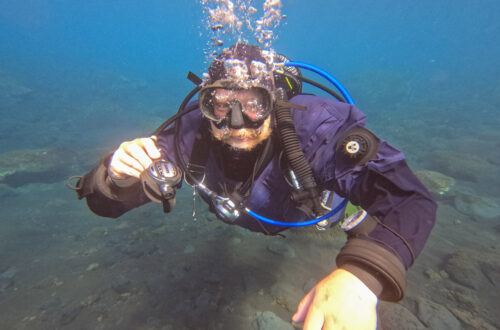

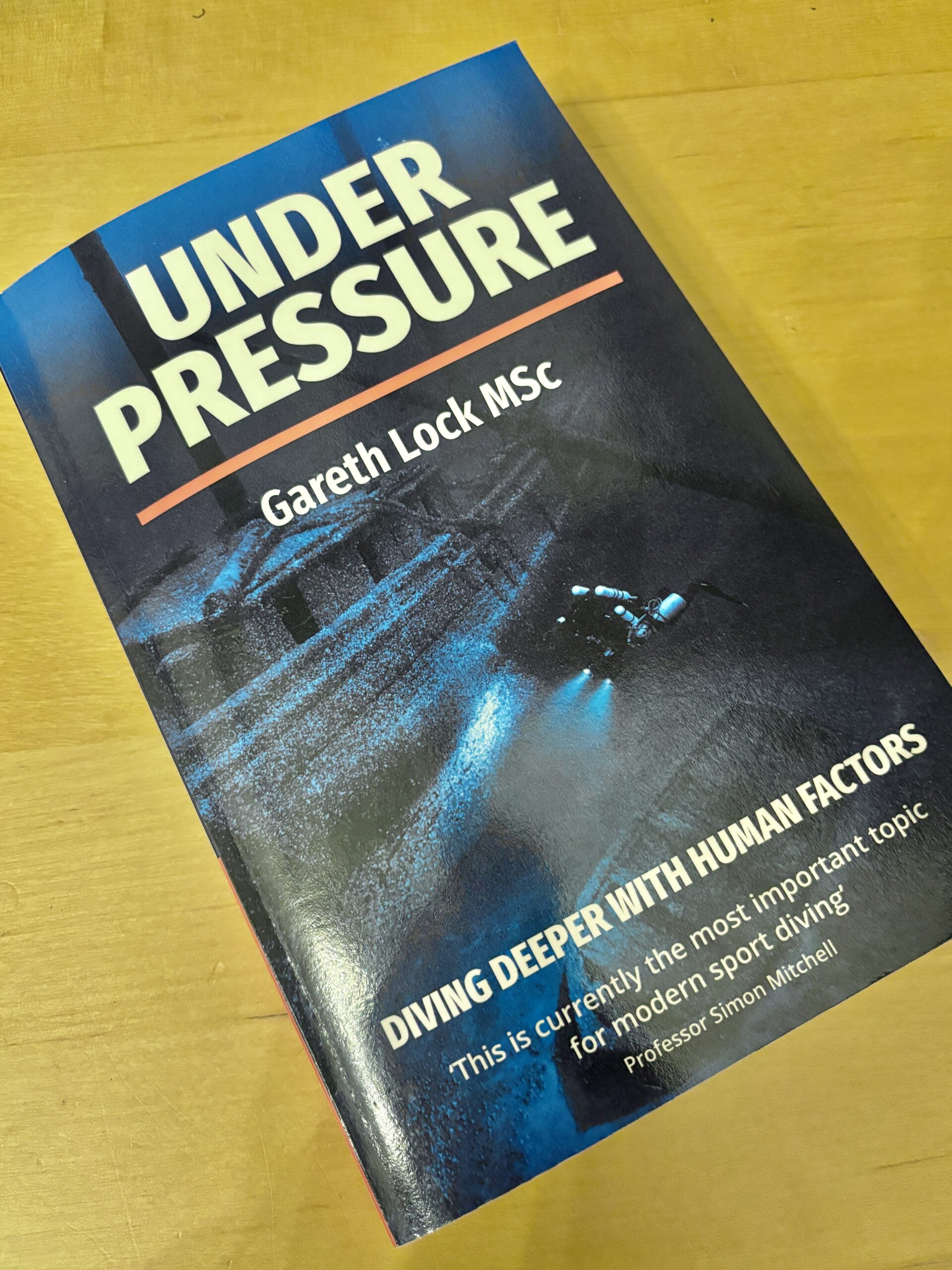
Under Pressure: Diving Deeper with Human Factors – Gareth Lock
As divers, we like to obsess over gear, training, and conditions. As humans however, we are inherently fallible, and subconscious biases can (and will!) influence our decision making. This is commonly called “human error.” Gareth Lock’s Under Pressure shows that making mistakes is normal, and that we should consider that fact in our planning. If we anticipate and detect small errors early, we can correct them before they become a critical failure.
First Impressions
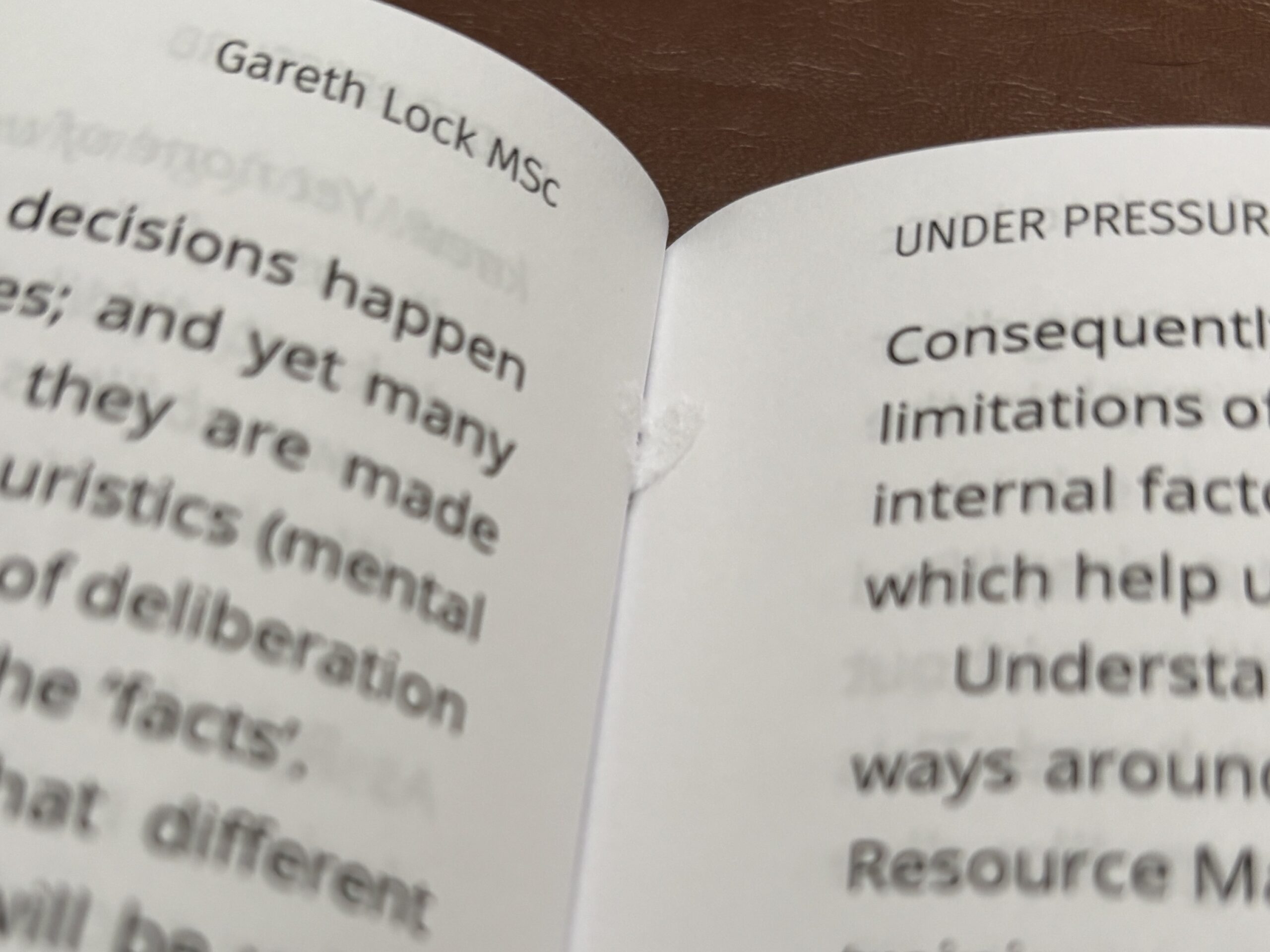
The book is a standard octavo format (c. 15×22cm, 6×9in) and glue bound with thin cardboard covers. It has a nice solid, and weighty heft to it. The block is crisply cut, there were some marks on the outside which may have come from the riving process, or maybe happened in transport. When first opened, there was a slightly uncomfortable smell from the printing and binding process which has not dissipated as much as I would have expected. The paper stock is fairly thin and has some visual bleed from preceding and following pages.
The paper is matt, and is easily read in any lighting. The binding is not a lay-flat binding, but a solid block. However, the inner margins are big enough that this does not present a problem while reading (more about the layout below).
One disappointing production artefact is a glue bleed from the binding process in the top third of the book, meaning some pages are stuck together in the inner margin and tear when opening the spread fully. The colophon is minimalist, the simply references a publisher (“Vision Maker Press”) which no longer seems to be in business. The front and rear cover feature some heavily processed photos; as a photographer, it pleases me that the photographers of these photos are credited in a prominent position in the colophon.
After reading the book, the cover and spine are not noticeably cracked or peeling. It remains to be seen whether this will still be the case after revisiting the book a few times.
Gareth Lock
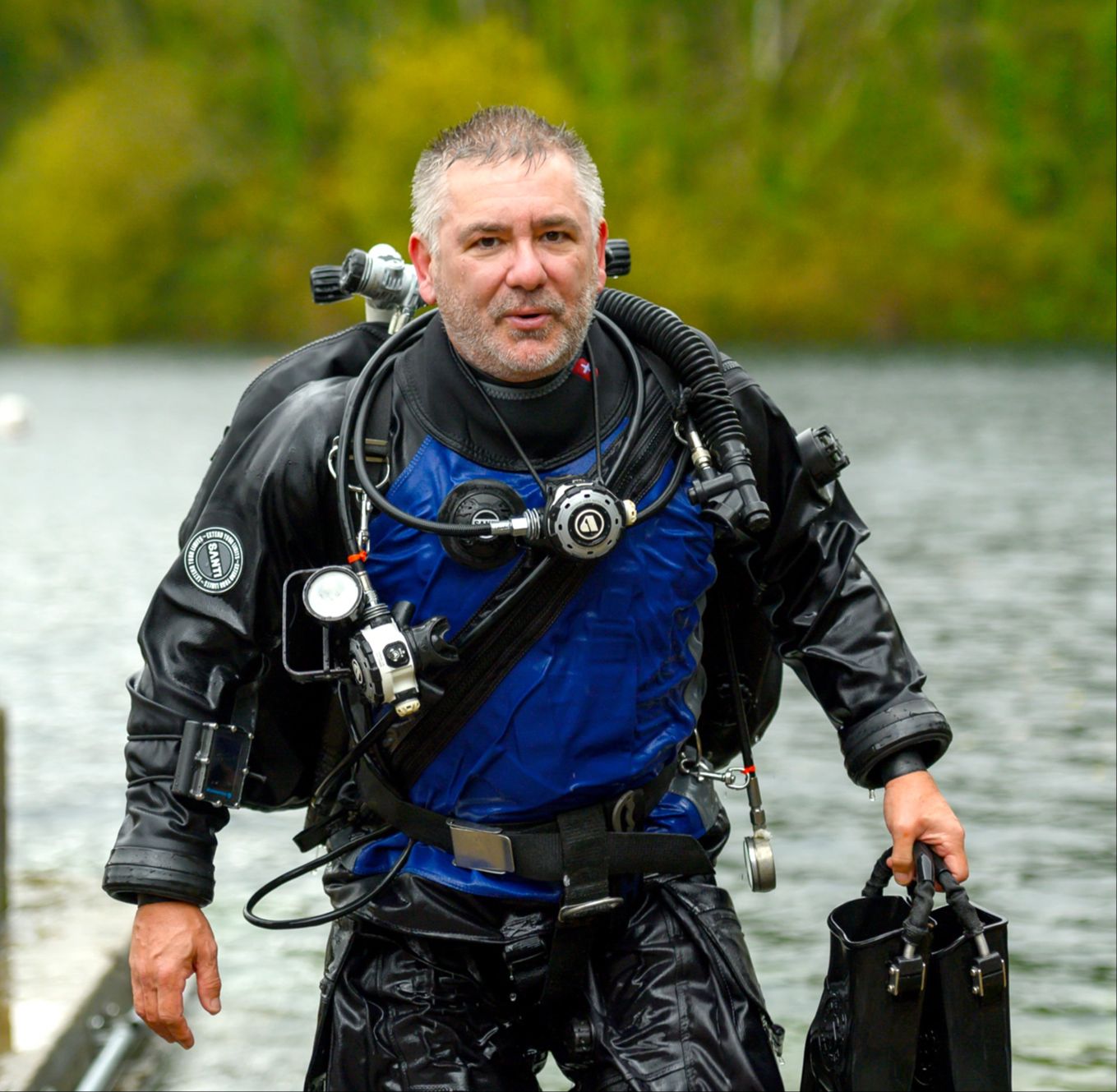
Gareth Lock is a retired Royal Air Force senior officer Navigator of 25 years, who was both a senior supervisor and a tactical flight instructor on an operational C-130 flying squadron. He has a MSc in Aerospace Systems from Kingston University and spent his last 5 years in the RAF as a Requirements Manager for Defensive Aids Systems working across all levels of industry, research and the military from front-line user to very senior officers, both in the UK and in the US, often at highly classified levels.
Gareth is an Open Circuit advanced trimix diver (Technical Diver Level 2 with Global Underwater Explorers) and normoxic trimix CCR diver (JJ-CCR with TDI) with around 800 dives over 12 years of diving. He is also an accomplished underwater photographerwith a deep interest in cold, green water wreck diving.
(Text excerpted from https://www.thehumandiver.com/about)
Key Themes from the Book
Knowledge is not enough
We must apply
Willing is not enough
We must do.
Lock opens the book with an overview chapter outlining the structure of the book, before going on to introduce the concept of “Human Factors” (funnily enough, he also states that “Human Factors” is not necessarily the correct term). The following chapters cover a range of topics from diving safety, human error, risk and uncertainty, communication and teamwork, leadership and learning from failure.
Each chapter opens with a case study of a situation where something went wrong, which is then used to introduce the topic of the chapter. A second case study, usually highlighting the application of the skills or tools introduced in the chapter, follows later on. A bullet-list summary of key points and questions to consider round up the chapters.
The final chapter is like a “too long, didn’t read” summary of all the content of the book – I freely admit to jumping to this chapter to see how it all ties together. This, in combination with the key point summaries from each chapter on its own would be a great reference sheet.
Error is Inevitable
One point Lock emphasises again and again is that errors and mistakes will happen. It’s not a question of if, it’s a question of when. As a retired pilot, he draws a lot of parallels to aviation. Aviation is inherently dangerous (falling out of the sky would be a Bad Day™ in anybody’s book…), but the industry as a whole has invested a lot of time and effort into ensuring that when errors occur, they are discussed and handled openly.
By introducing a Just Culture, and allowing failures to be acceptable, Lock suggests that diving can become safer. Once it becomes common-place to own up to mistakes and learn from the outcomes, everyone can benefit. This culture means there is no stigma to making errors and small mistakes will be corrected early and in time, before they become critical.
Situational Awareness
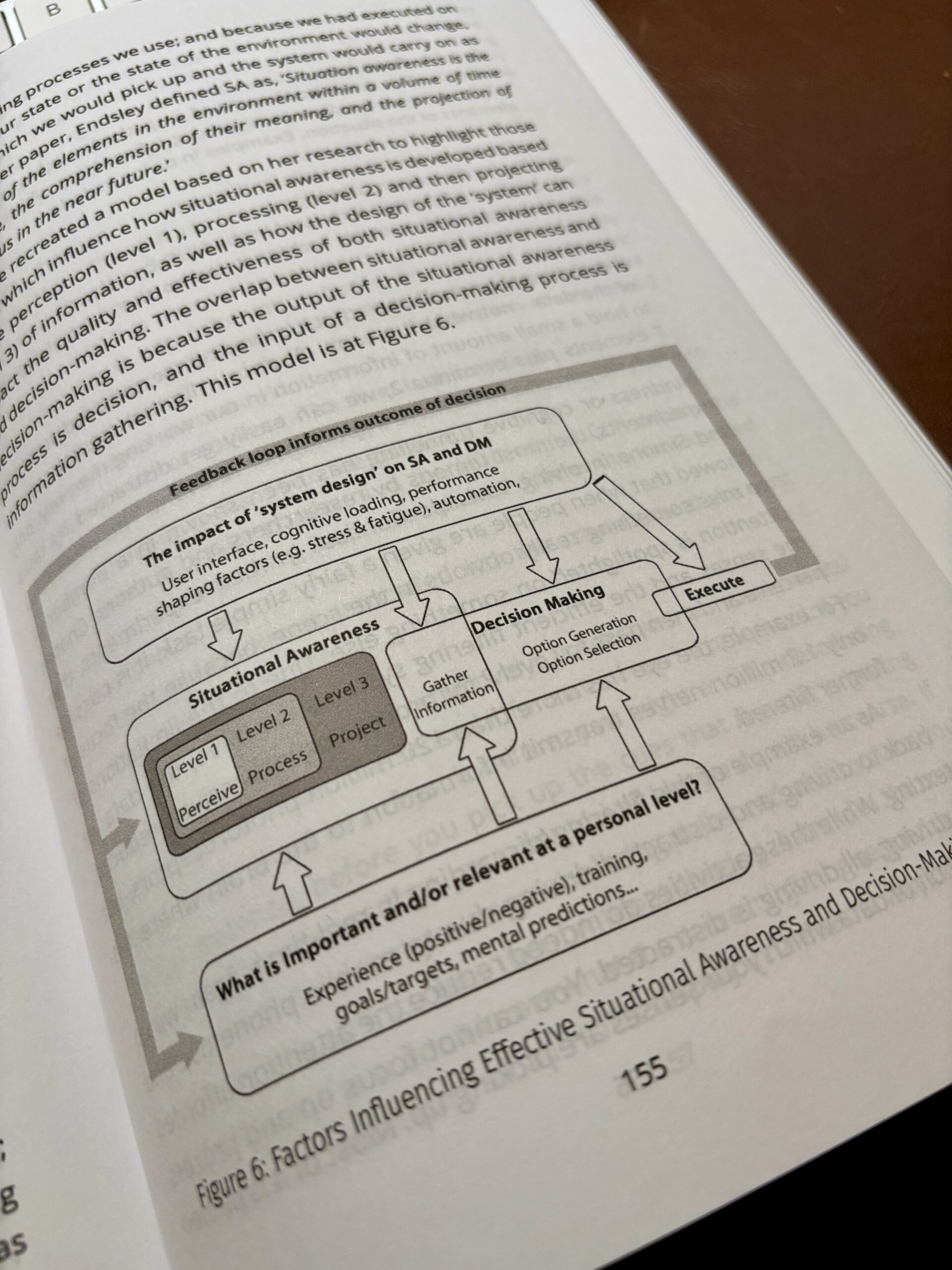
As divers, we have all heard of the concept of “task loading” (If you haven’t, talk to one of your trusted instructors). Our brains have a limited capacity for processing data and inputs from our surroundings. If we are struggling with new equipment, new environments or new procedures, we effectively start suffering a form of tunnel vision and the mind blanks out a lot of other inputs.
There’s a fantastic video I saw recently of 2 students practicing an air-sharing drill while a whale shark swims by behind them that they did not see. They were concentrating so hard on the drill that they did not have the capacity to process anything else around them. We’ve all experienced similar situations – Lock provides detailed insights how we can deal with this phenomenon in chapter 7.
Communication and Trust
Lock discusses how psychological and social barriers can prevent meaningful communication. In chapter 8, he goes into the details of a number of different communication models which can be used to effectively convey content and meaning. Non-verbal communication is something we should also be aware of, especially in an underwater environment where body language is one of the only ways we have of communicating.
Good communication is an enabler for building trust. Lock stipulates that “[a] team is not a group of people who work together; rather, a team is a group who trust each other […]” (Under Pressure, p. 12). Creating trust requires leadership, but effectively taking a leadership role is a challenge many people have not considered. Lock offers strategies for developing high-performing teams, and also highlights why some teams will inevitably fail.
Learning Culture
Just Culture is a term that we encounter relatively frequently in the book. It is a term from aviation that means there is a distinction between genuine human error and reckless behaviour. The former is taken as a learning opportunity, while the latter should be actively discouraged – through education or leadership. A Just Culture offers a blame-free environment where participants can own up to mistakes without fearing retribution.
By allowing members of a community to own their mistakes, learning opportunities are opened up; at the same time, small mistakes can be corrected early rather than being hidden. In turn, this also helps to prevent catastrophic failures.
Lessons Divers Can Apply
Even though I’ve been diving for years, I’m still relatively inexperienced. One of the key takeaways for me from this book is to admit to mistakes and uncertainty. It also encourages me to start thinking about how I will brief dives or how I will conduct debriefings. The main focus should always be on learning, and this is something I think applies outside of diving as well.
Why Every Diver Should Read It
Lock has built up a complete education ecosystem around the topic of Human Factors in diving – see the website www.thehumandiver.com. However, this book (and system in general) should not be seen as a manual, but more of a mindset shift. Anyone involved in diving with other people should definitely read the book – not just instructors and technical divers. It offers a set of tools for rational decision-making, building teams, and improving communication and culture.
While books like Deco for Divers give us technical instruction, Under Pressure is a good explanation of the psychology behind a lot of diving situations. For me, moving forward, I will be keeping a lot of these topics in mind.
Rating
The content is very well presented and well thought out. The layout and typesetting lets it down – with no disrespect to Gareth Lock, the typesetting feels very amateurish. So while it does not score very well on the layout marks, I’m not including that in the final score, as the content itself and the rest of the book deserve the 4.5 stars.
Quality
Layout
Content
Total
Colophon
Title: Under Pressure – Diving Deeper with Human Factors
Authors: Gareth Lock MSc
Publisher: Vision Maker Press
Publication date: March 2019
Language: English
Print length: 333 pages
Paperback ISBN: 978-1-9995849-7-9
RRP: £30.00
Purchased from Gareth Lock in person, 2/3/2025 for £30.00
Links
Gareth Lock’s website and blog:
Get your copy from Amazon UK (I may earn a small commission if you purchase through these links):
Alternatively, get it from Gareth directly:
What was the most valuable human factors lesson you've learned from diving? Let me know in the comments down below. If you have any recommendations for related reading, also let me know down below.


You May Also Like

Training Log – Preparing for Instructor Pathway
2025-09-23
Deco for Divers – Mark Powell
2025-09-16